
BJJ for Self-Defense: Useful Skills and Honest Limits
Considering BJJ for self-defense? Understand what grappling practice can teach, what sport training leaves out, and what to ask before starting.
Published 4 min read
Editorial archive · . The archive date organizes this guide series. Publication is recorded above.
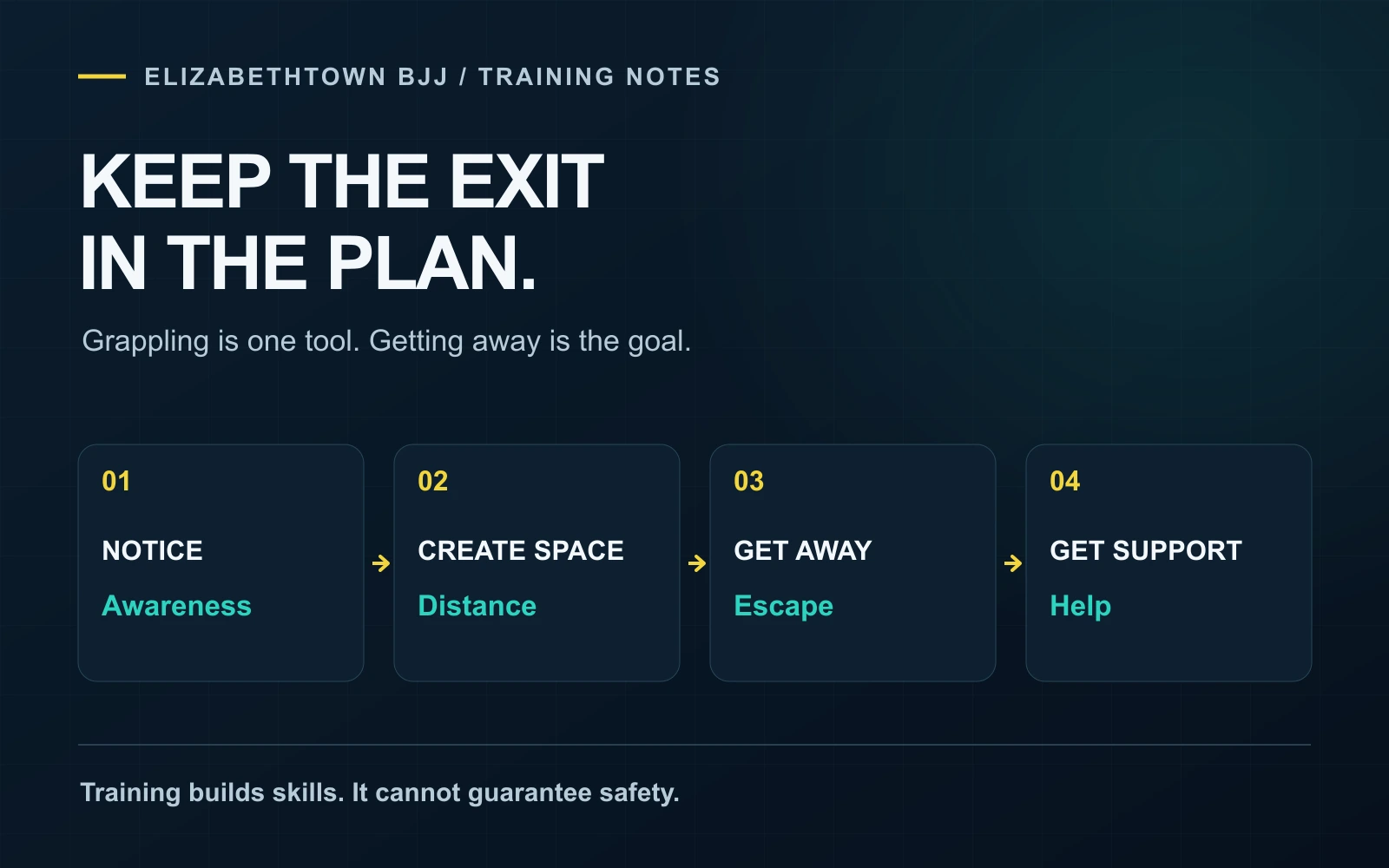
If you are looking for jiu-jitsu in Elizabethtown because you want to feel better prepared to protect yourself, ask what that goal means in practice. Brazilian Jiu-Jitsu can teach you about grappling, balance, position, and escaping control. It cannot promise a safe outcome in a confrontation.
A useful conversation starts with both sides of that statement. You should understand what you will practice and where the limits are before treating any class as a complete answer to personal safety.
Keep the goal clear: Personal safety is about getting out of danger. Winning a grappling exchange and getting away safely are different objectives.
What grappling practice can teach
BJJ puts close contact into a learning setting. You practice with partners, work through positions, and learn how movement and resistance change a technique. Instead of judging a movement only by how it looks in a demonstration, you have opportunities to test it under the coach's direction.
That can make questions more concrete. Can you recognize when someone has controlled your position? Can you follow an escape sequence during the exercise? Can you notice when using more effort is making the problem worse?
Those are skills to develop, not guarantees that they will transfer perfectly to an emergency. Training partners, mats, rules, and an agreed stop signal create conditions that an assault does not provide.
Understand what a sport round leaves out
In a normal BJJ round, partners agree to a ruleset. They know who they are training with, which techniques are allowed, and that the action must stop for a tap. In a tournament, officials and scoring add another layer of structure.
A confrontation may involve strikes, a hard or uneven surface, concealed weapons, or additional people. The environment can change while your attention is on one person. No amount of confidence on the mats makes those factors disappear.
For that reason, do not assume every sport tactic is a sensible choice for personal safety. A position that is useful for scoring or submitting a resisting partner in a controlled round may keep you occupied when your priority should be leaving. Discuss that difference with a coach rather than trying to adapt techniques on your own.
Multiple attackers and weapons change the problem
Grappling with one person can limit your ability to move away or see someone else approach. A weapon adds dangers that an unarmed training round does not reproduce. Claims that a single technique reliably solves either situation deserve scrutiny.
Treat demonstrations as exercises with assumptions. Ask which conditions the exercise leaves out and what the coach wants you to learn from it.
If you can avoid a confrontation, create distance, leave, or seek help, those options matter. You do not owe anyone a demonstration of what you have learned. In an immediate emergency, contact emergency services when it is safe to do so.
Questions to ask a school about your goal
- Which parts of the beginner curriculum relate to escaping control and returning to your feet?
- How do you explain the difference between sport decisions and self-defense decisions?
- Does the class include strikes or scenario practice, or is it grappling only?
- How is resistance introduced, and what makes a drill appropriate for a new student?
- What subjects would require separate instruction rather than being covered in this class?
Those questions are not a request for a coach to promise everything. A specific answer about what is taught is more useful than a broad assurance that you will be ready for any situation.
Keep confidence tied to what you have practiced
It is possible to become more familiar with grappling while remaining a beginner. That is a reason to keep learning and asking questions. It is not a reason to take risks you would otherwise avoid.
If your concern is a specific ongoing danger, seek appropriate local help. General training advice cannot assess the circumstances you are facing.
For a local first visit, the beginners program describes the starting point. Tell the academy what you want to learn and ask how that goal fits its actual classes.