
BJJ, Karate, or Wrestling: How to Choose
Compare BJJ, karate, and wrestling by what you practice, how contact works, and the questions to ask before choosing a class for yourself or your child.
Published 4 min read
Editorial archive · . The archive date organizes this guide series. Publication is recorded above.
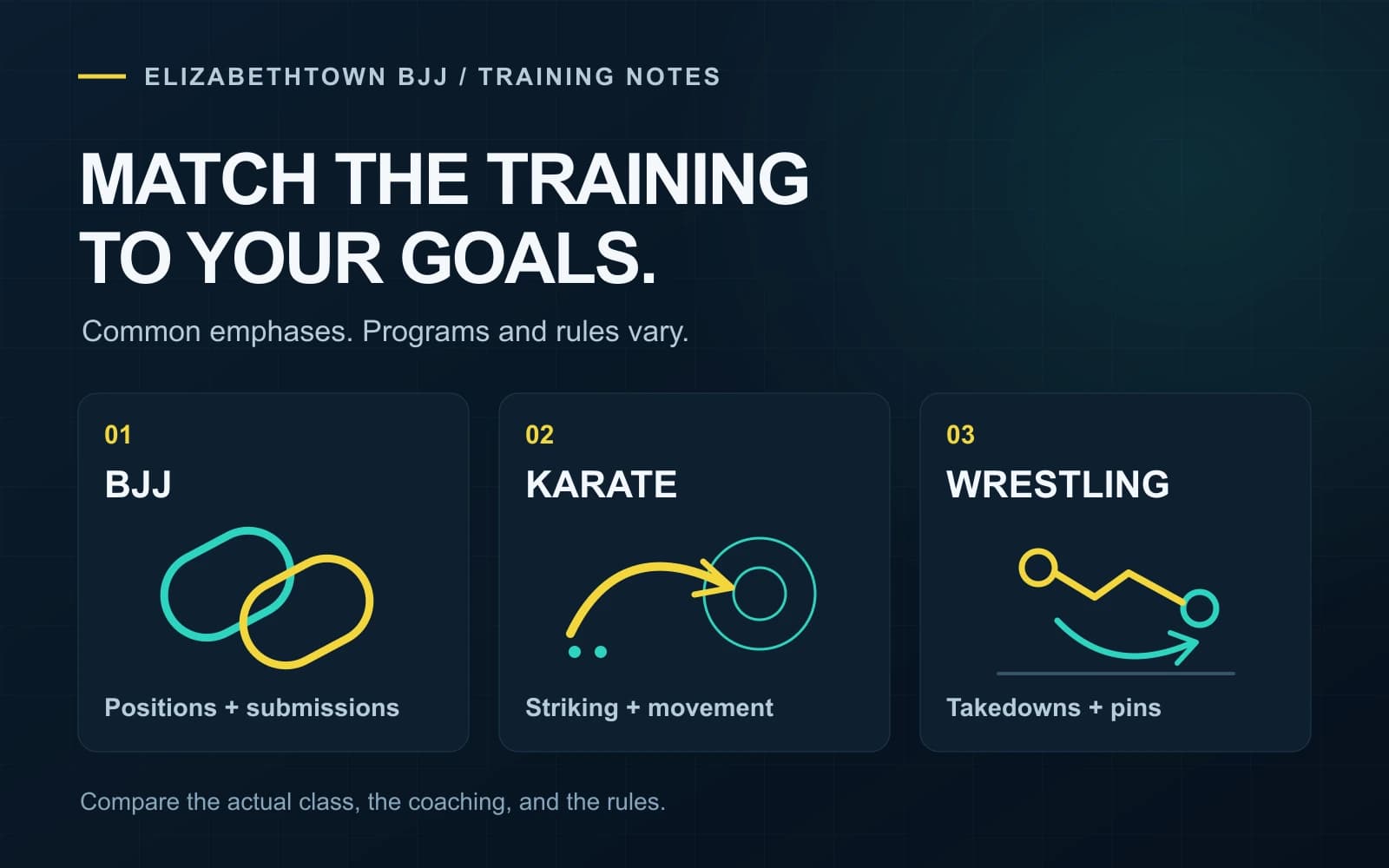
If you are comparing jiu-jitsu, karate, and wrestling in the Elizabethtown area, start with what you or your child wants to practice. These activities overlap in some habits, but the rules give students different problems to solve.
A sport's name does not tell you everything about a particular room. Coaching, beginner placement, contact rules, and the weekly schedule still need checking. Use the broad differences below to narrow your questions, then visit the program you are considering.
Ask to see the practice: watching how a beginner is taught is more useful than deciding from uniforms, belt colors, or a claim that one martial art is best for everyone.
BJJ: grappling, positions, and submissions
Brazilian Jiu-Jitsu centers on controlling positions, escaping them, and applying permitted submissions with a partner. Training can include standing work and ground work. The curriculum and the balance between them depend on the academy and class.
In sport BJJ, being on your back does not automatically end the match. A student may use a guard position, with their legs helping manage the person on top. This is one reason a wrestling exchange and a BJJ exchange can look different even when both involve grappling.
Sport rules also differ between BJJ events and age or belt divisions. The IBJJF rule resources are one example. For an ordinary class, ask the coach what is permitted for your level rather than copying a move from a competition video.
Karate: techniques, forms, and sparring
Karate commonly teaches striking skills such as punches and kicks. Depending on the school, practice may include basic technique, forms, partner exercises, and sparring. The amount and kind of contact vary, so ask about the actual class.
In organized sport karate, kata is the performance of a defined sequence of techniques, while kumite involves an opponent. The World Karate Federation publishes separate kata and kumite rules. Those competition categories help explain the terms, but they do not describe every karate school's teaching approach.
If forms appeal to you or your child, ask how they are taught and how much of a beginner class they occupy. If the interest is sparring, ask when it begins, how contact is controlled, and what equipment is required. Avoid assuming that every karate class follows the same pattern.
Wrestling: takedowns, control, and pins
Wrestling is also grappling, but its rules create different goals from submission-based BJJ. Wrestlers work to control an opponent and can win through a pin or the scoring system used in their style. Chokes and submission locks are not the objective.
There are important differences within wrestling. USA Wrestling's rulebook explains freestyle and Greco-Roman and notes that folkstyle has separate regulations. Ask a program which style it teaches, how it introduces beginners, and whether participation involves a competition season.
A wrestling background can give a new BJJ student familiar experiences with balance and partner resistance. It does not remove the need to learn BJJ's rules. Likewise, a BJJ student joining wrestling should learn that program's goals rather than assuming the same habits apply.
Compare the kind of practice you want
Think about the activity itself before the promised benefits. Would you enjoy repeatedly working through close-contact positions with a partner? Are you interested in learning striking technique? Does a school or club wrestling setting appeal to your child?
You can be interested in more than one. You can also discover that the class you enjoyed watching feels different when you try it. An introductory visit gives you information that a style comparison cannot.
For children, ask how the instructor manages attention, partner matching, and requests for a break. For adults, ask how a new student joins the lesson and what they need to understand before any live practice. All three activities deserve those questions.
When visiting, ask which session suits a beginner, how partner tasks are introduced and what equipment is needed. Use the school-choice guide for the full visit comparison. Elizabethtown BJJ’s beginners program is the local starting point for new adults.