
After a Hard Kids BJJ Class: A Parent’s Conversation Guide
Useful questions after a frustrating class, when to speak with the instructor, and how to keep a child’s experience at the center of the conversation.
Published 3 min read
Editorial archive · . The archive date organizes this guide series. Publication is recorded above.
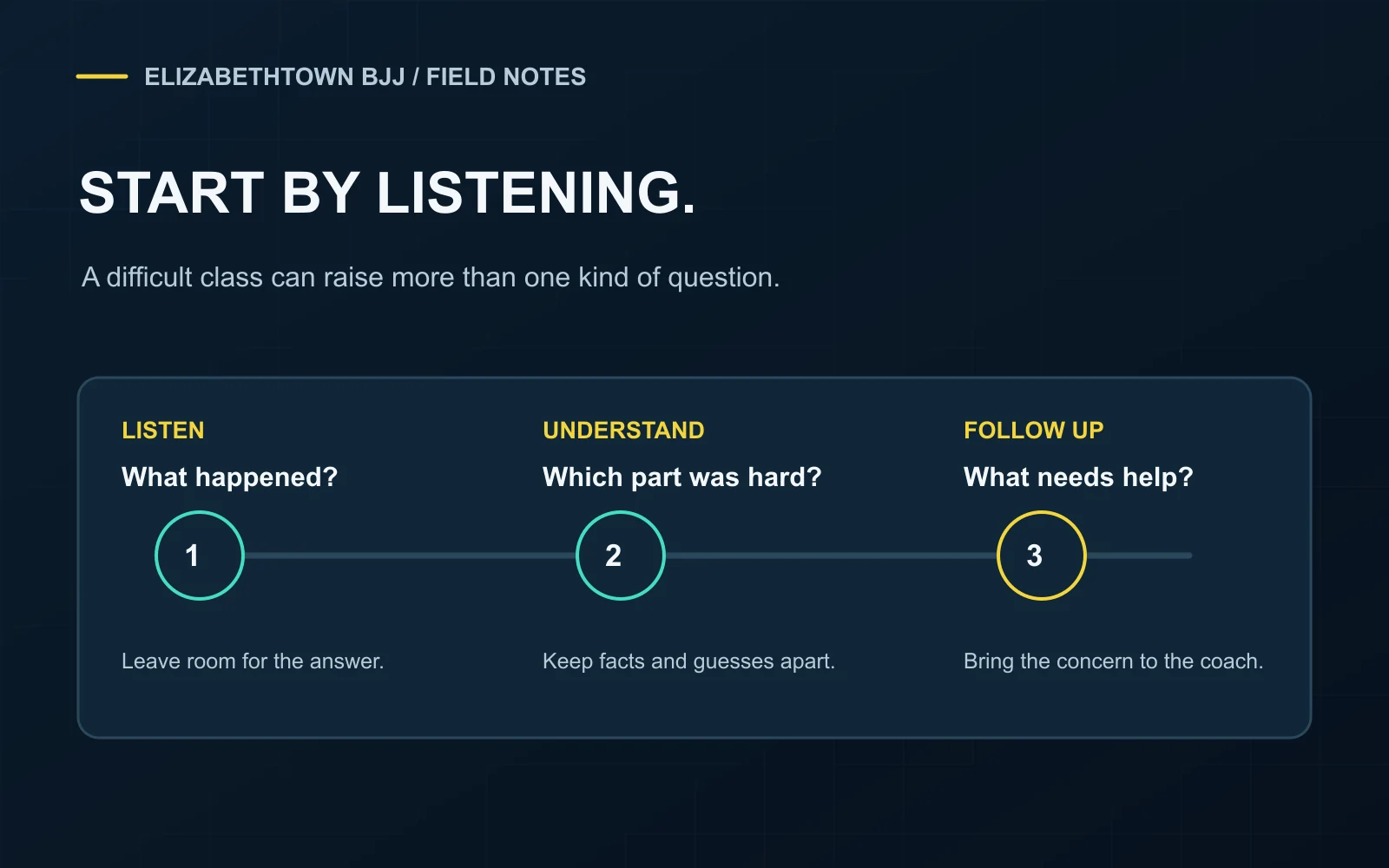
If your child leaves the mat upset, find out what happened and whether they need help now before asking whether they won a round. A disappointing exercise, confusion about instructions, pain, and a partner ignoring a stop signal are different situations. They need different responses.
This is a conversation guide for parents, not a diagnosis of a child’s behavior or a promise that martial arts will fix it. Start with the experience your child describes.
Leave room for the first answer
Try one open question: “What was the hardest part today?” Then listen. If the answer is “everything,” offer a small choice: “Was it understanding the activity, working with someone, or something else?” The choice helps identify a moment without telling the child what they must have felt.
Give a child who needs a little time that room. The trip home does not have to become an immediate technical review. You can say, “We can talk when you are ready. I want to understand.” Avoid promising secrecy about something that may need an adult’s help.
Match the next question to what happened
- “I did not understand.” Ask which instruction or position was confusing. Help turn it into one question for the instructor.
- “I kept losing.” Ask what the activity’s task actually was. A practice exercise may have a different goal from the score the child kept in their head.
- “I did not want that partner.” Ask what made the pairing uncomfortable. Bring a specific concern to the coach without asking the child to handle it alone.
- “It hurt” or “they would not stop.” Stop treating the situation as an ordinary disappointment. Attend to the child, involve the instructor promptly, and seek appropriate care when needed.
These prompts organize a conversation. They do not establish what occurred in a class. Keep the child’s actual words separate from your interpretation when you speak with the coach.
Describe the moment without grading the child
“You stayed with the explanation after you were confused” names something you observed. “You are a natural” gives the child a label to live up to. “Why did you let that happen?” can turn an uncertain account into a defense of their performance.
You can be specific without pretending a difficult class was fun. For example: “That sounds frustrating. Do you want help asking the coach what to do when you get stuck there?” The response acknowledges the problem and offers a next step the child can understand.
Try three short lines: “Tell me what happened.” “What do you want me to understand?” “Here is what we can ask the coach.”
Give the instructor a question they can answer
A useful message might be: “My child said they could not follow the reset rule in today’s partner exercise. Could you clarify the rule and help us understand how to ask for help next time?” That is a hypothetical example. Replace it with what your child actually reported.
For a concern about pain, a boundary, or a stop signal, be direct about that concern. Do not reduce it to “they had a bad attitude today.” If the first answer leaves something unresolved, ask a follow-up and decide what participation is appropriate while it is addressed.
Review the pattern, not just one class
Over time, notice whether the child wants to attend, understands how to ask for help, and feels heard when something is wrong. Repeated distress deserves a fresh conversation about the class, the coaching fit, and the child’s wishes. Persistence should not mean ignoring what the child is telling you.
If your family is still deciding whether to begin, the kids readiness guide covers that earlier decision. For an existing class question, use the academy’s contact page to arrange a conversation about your child’s actual experience.