
BJJ Belts and Stripes: What to Ask About Progress
The main adult belt colors, why stripes and timelines vary, and better questions to ask about your own learning and a child’s progress.
Published 3 min read
Editorial archive · . The archive date organizes this guide series. Publication is recorded above.
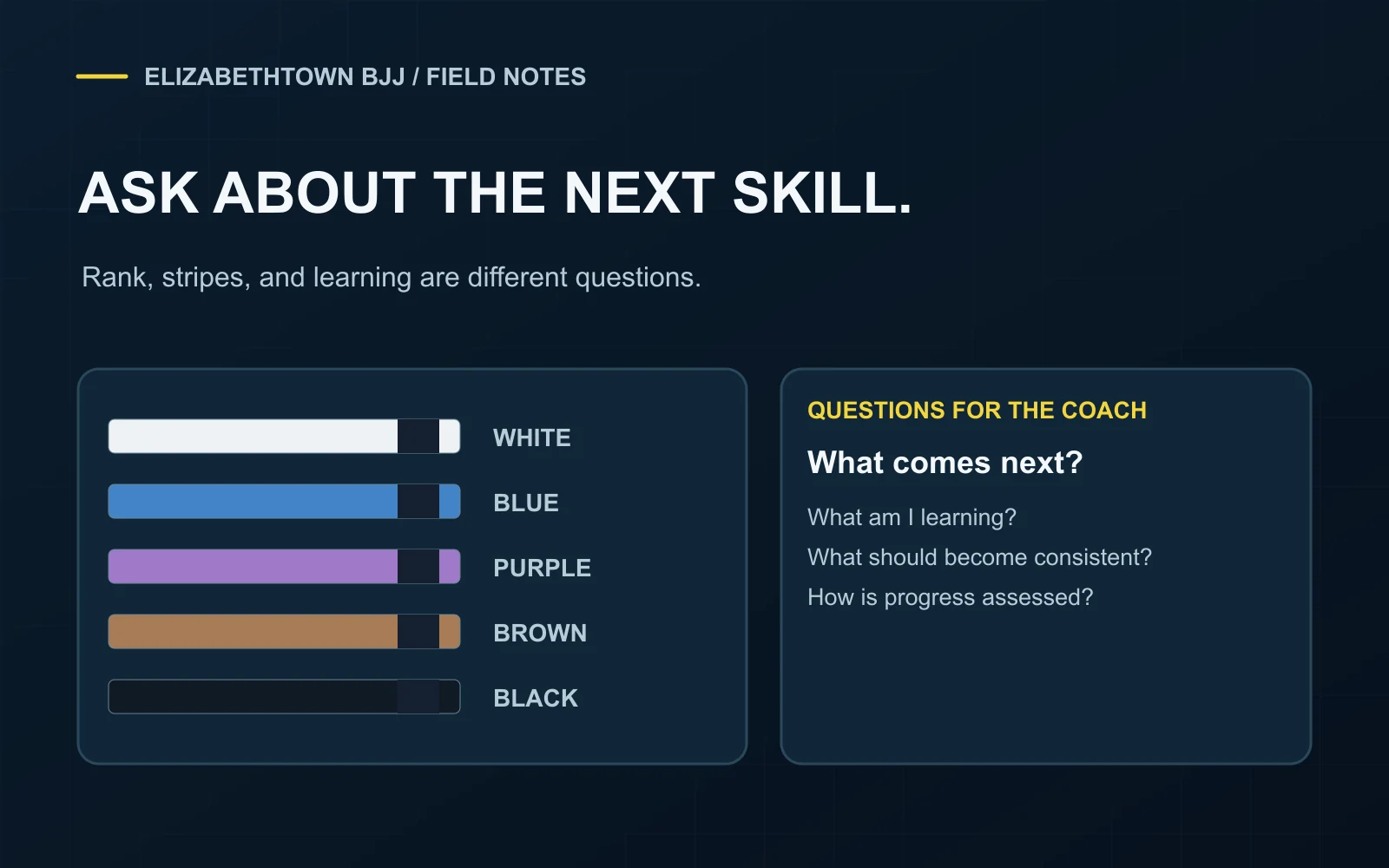
A belt is a rank within a school and its governing context. It gives you some information about experience, but it is not a stopwatch, a promise about the next promotion, or a reliable prediction of how any particular round will go.
If you are starting BJJ, learn the broad adult sequence and ask your instructor how progress is assessed at this academy. If you are a parent, ask specifically about the children’s system. Those conversations are more useful than trying to turn a chart online into your promotion date.
The familiar adult sequence
The main progression most adult beginners encounter is white, blue, purple, brown, then black. The IBJJF graduation system also sets age and minimum-period requirements for its recognition framework and describes ranks beyond black belt. Its published requirements are not a guarantee that someone will be promoted when a minimum period ends.
Keep those ideas separate: an organization can describe eligibility conditions, while an instructor still evaluates whether to award a rank. Do not treat a minimum as a deadline or assume that every academy uses the same assessment process.
Stripes need a local explanation
Stripes can mark progress within a belt, but their meaning and award process can vary. Ask how they are used in the program you attend. A stripe from one setting cannot automatically tell you how another school tracks attendance, technical understanding, or other expectations.
A student training without a gi may not wear a visible belt during class. That does not remove the need to communicate actual experience and follow the class’s rules. Likewise, a belt color does not excuse unfamiliar or uncontrolled technique with a partner.
Children use a different framework
Children’s belt systems include colors that are not part of the standard adult sequence. The IBJJF publishes a separate children’s framework and different suggested stripe systems. Ask the academy which system it uses and how it handles the transition between age groups.
For a parent, useful questions are: “What skills is my child working on?” “How will you tell us they are ready for the next step?” and “What should we focus on between evaluations?” Avoid promising a child a belt on a date that the instructor has not given.
Save a four-question coach card
- What should I understand more clearly at this stage?
- Which recurring mistake should I work on first?
- How should I practice that within the class?
- How does the academy communicate promotion expectations?
Keep a progress note that does not depend on a promotion
Choose a position you encounter often and record a few observable details: whether you can name it, understand the first task, follow the coached movement, and make a decision when a partner responds. Ask the instructor which observation is appropriate for your stage.
For example, recognizing that you are in half guard and knowing which question to ask is different from performing an entire escape against resistance. Both observations can help a coach understand where you are. A single training outcome cannot settle all of those questions.
When changing schools, bring accurate information
Tell the new instructor your rank, previous school, training background, and any long gaps. Ask how they handle an incoming student’s rank and program placement. Do not assume you need to start over, and do not assume a previous arrangement automatically transfers unchanged.
If your real question is how to begin learning, use the first-month guide. If it concerns your child’s experience, the parent’s guide is a useful starting point. For current rank and progression questions at Elizabethtown Jiu-Jitsu, ask the academy directly. No generic chart can give that answer on its behalf.