
Your First BJJ Class: A Guide to Your First Month
Make sense of your first BJJ class and the weeks after it. Learn the main positions, useful questions, and progress markers beyond winning rounds.
Published 4 min read
Editorial archive · . The archive date organizes this guide series. Publication is recorded above.
Your first month of Brazilian Jiu-Jitsu can feel like learning directions in a place where every street has a new name. You hear “guard,” “mount,” and “pass,” then try to remember where your hands and feet belong.
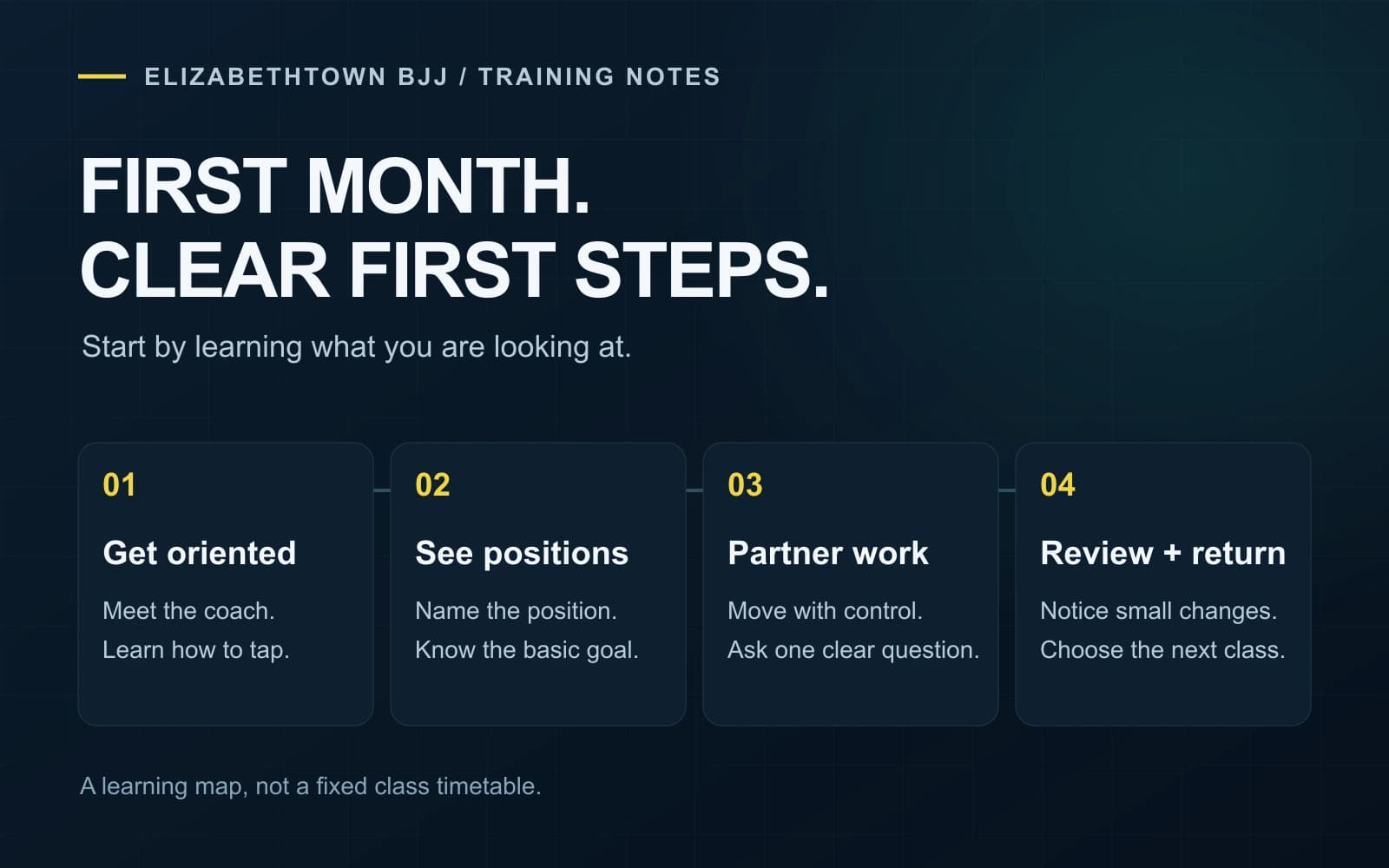
You do not need to learn everything at once. A small map helps: understand how to practice with a partner, recognize the main positions, and give each class one manageable purpose. Use the stages below as a guide to discuss with your coach, not a fixed academy syllabus or a deadline.
Measure what you understand: naming a position, asking a clearer question, or following a drill without losing the goal is progress. A submission count will miss most of that.
First visit: learn how the room works
Before attending Elizabethtown BJJ, check the schedule and confirm a suitable first session with the gym. Arrive 10 to 15 minutes early at 101 Cherry St in Elizabethtown. Bring water and workout clothes unless the coach gives different instructions. Our gi, no-gi, and gear guide explains what to ask about clothing.
Tell the coach that you are new. Before partner work, ask them to explain the assigned task, how to tap and give a verbal stop signal, and what participation is appropriate for you. Release immediately when a partner taps or says stop. Ask for help when the situation is unclear.
A useful first-day result is simple: you know how to begin a drill, how to stop it, and which class to attend next.
Early classes: build a position map
Instead of collecting move names, learn to recognize where you are. These broad descriptions are vocabulary, not instructions for applying a technique:
- Guard: a position where the person underneath uses their legs to manage the person on top. There are many kinds of guard.
- Side control: the top person controls from across the other person's torso, past their legs.
- Mount: the top person sits over the other person's torso with a leg on either side.
- Back control: one person controls from behind the other. The details of that control vary.
Learn both people's names for the same situation. Being on top of someone's guard is different from being in mount, even though you are above them in both. Recognizing the difference makes the coach's next instruction easier to follow.
After a demonstration, ask two questions: “Where are we starting?” and “What is each person trying to do?” You can then work on the movement without losing the purpose.
As the terms settle: connect a problem to a response
A beginner does not need a complete answer for every position. Start by identifying the problem the coach is teaching that day. Perhaps the person underneath needs to make space. Perhaps the person on top needs to maintain balance while the partner moves.
Use the assigned technique rather than adding something you saw online. Ask the coach to watch a repetition if you cannot tell why it stops working. “My partner moves away before I can do the next step” gives them something specific to observe.
If positional practice is part of your session, confirm its start, goal, and reset rule. Limited tasks can make an exchange easier to understand. Do not quietly change the exercise into an unrestricted round because the first attempt failed.
Through the month: keep a small record
Write three lines after class: the starting position, the main goal, and one question. Use plain words if you do not remember the technical name. “On my back with their weight across me” is enough to start a conversation next time.
For example: “Side control underneath. Goal: make enough space to begin the escape we drilled. Question: when did I lose the space?” That note is more useful than writing that you had a bad class.
Look back after several visits. Are your questions becoming more precise? Can you remember the task without watching your partner begin? Those are things you can notice even while experienced students remain difficult to move.
At the end of the month: choose the next useful step
Ask your coach what to keep working on and which classes suit your current level. Do not use a calendar date to decide that you should be ready for harder rounds, open mat, or a belt. The amount of practice and the individual student both matter.
Five progress markers worth checking
- I communicate clearly and stop promptly.
- I recognize a few main positions.
- I understand the goal of the assigned drill.
- I can describe one problem I need help with.
- I have a realistic plan for returning to class.
Start with the beginners program and contact the gym about your first session. The first month is a beginning you can build on, not a test you need to pass.