
BJJ Points Explained: What the Scoreboard Is Counting
An introduction to IBJJF-style points, why a reversal is not always a sweep, and the rules questions to check for your actual event.
Published 3 min read
Editorial archive · . The archive date organizes this guide series. Publication is recorded above.
A BJJ scoreboard records particular actions under a particular ruleset. It does not count every time someone changes position or looks busy. Before studying the numbers, identify the event’s organizer, your division, and the current rules it uses.
This guide uses IBJJF-style scoring as an example. Other tournaments can change point values, use submission-only formats, or apply different overtime and penalty rules. Read your event’s rules rather than assuming that a familiar scoreboard tells the whole story.
The basic numbers, with an important condition
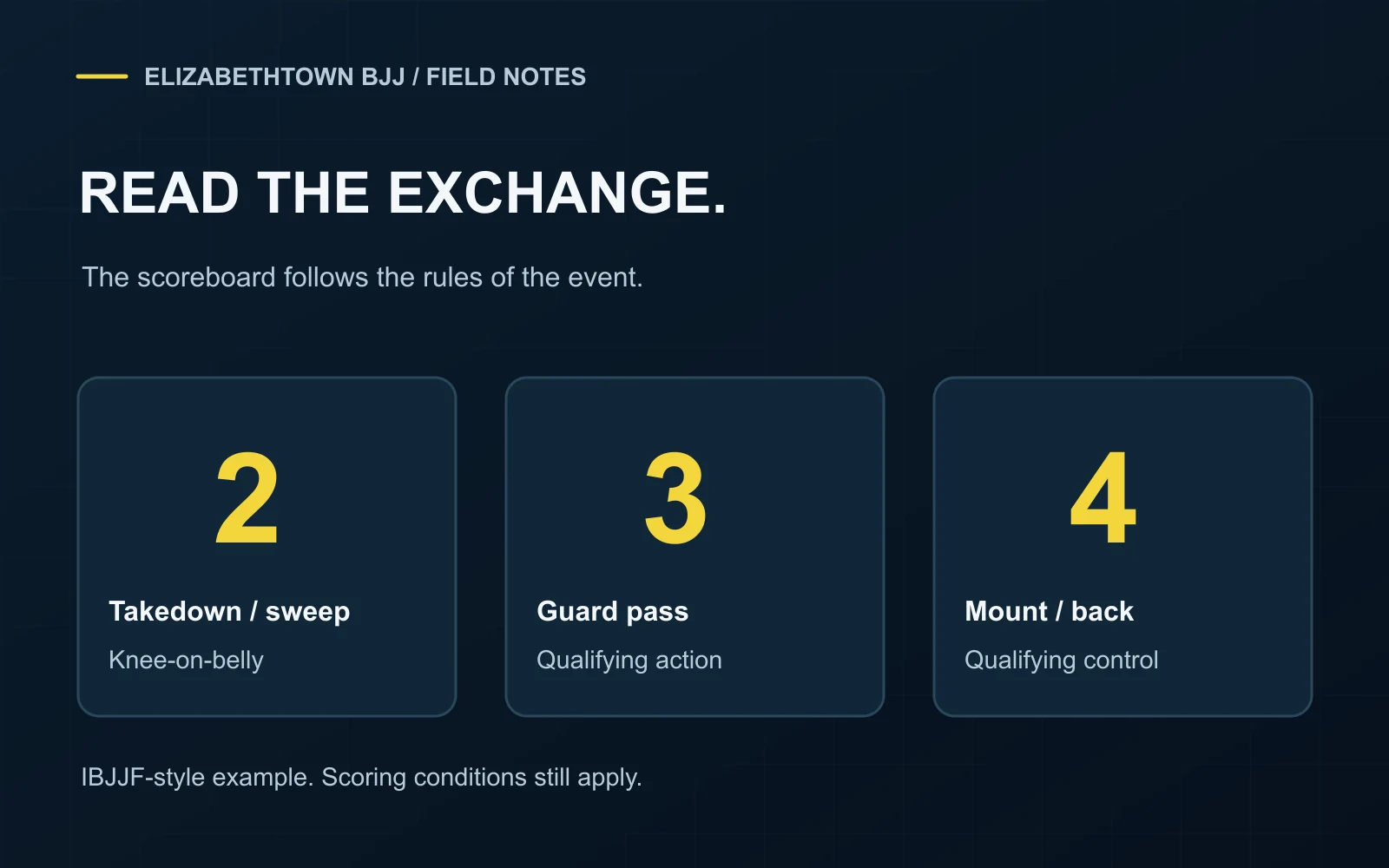
In the IBJJF rulebook, the main scoring categories include takedowns, sweeps, and knee-on-belly for two points; guard passes for three; and mount and qualifying back control for four. Each category has defined requirements. Many scoring situations require establishing the position for three seconds, with specific provisions and exceptions in the rulebook.
Those values are a memory aid. A brief shape that resembles a scoring position does not automatically earn its points. The referee must judge the action against the applicable criteria.
Three exchanges that often confuse new spectators
“They got on top. Why was that not a sweep?”
Under IBJJF rules, a scoring sweep begins from guard or half guard and must satisfy the rule’s conditions. Coming from bottom side control to the top can be a valuable escape or reversal without being a two-point sweep. “Top now” and “sweep points awarded” answer different questions.
“They are in side control. Where are the points?”
Side control itself is not a separate points category. The action that led there matters. A qualifying guard pass can score; reaching a similar-looking top position through a different exchange may not be a guard pass.
“They almost finished. Is that four points?”
Submission attempts are not a substitute for the position categories. IBJJF rules have separate criteria for advantages in certain near-scoring or near-submission situations. Advantages are counted separately, not as fractional points that eventually add up to a point.
Watch the sequence before looking at the referee
For a hypothetical exchange, imagine a competitor starts in the opponent’s guard, gets beyond the legs, and establishes a qualifying pass. To understand the decision, watch the starting position, the passage beyond the guard, and the control that follows. Looking only at the final still image loses the part that explains the score.
For a second example, imagine a competitor escaping bottom side control and coming on top. You can recognize the improvement without labeling it a guard sweep. That distinction makes a replay easier to discuss with a coach.
Replay note: Record the starting position, the action, the established position, and the referee’s decision. Mark anything the camera cannot show as uncertain.
Keep scoring separate from technique permission
Knowing the points does not tell you which submissions, grips, or movements are legal in your division. Age, rank, gi/no-gi format, and the organizer’s rules can matter. Ask the coach to review those details before you compete.
Also check the match duration, boundary procedure, penalties, tie resolution, and how questions or appeals must be raised. Rules can change; an old highlight video is not a current event briefing.
Use the scoreboard as one part of preparation
Choose one recent match under the relevant rules and watch it with a score sheet beside you. Write down where you expected points and compare that with the referee’s decision. Bring one discrepancy to your instructor instead of assuming the referee or your memory must be wrong.
The first-tournament checklist covers registration and event preparation. This guide helps with the narrower task of understanding the exchanges. For a training follow-up, the match-video worksheet turns a few recorded moments into questions for class.