
How to Review a BJJ Match Without Drowning in Notes
A three-pass video review and a small worksheet for turning one recorded exchange into a useful coaching question.
Published 4 min read
Editorial archive · . The archive date organizes this guide series. Publication is recorded above.
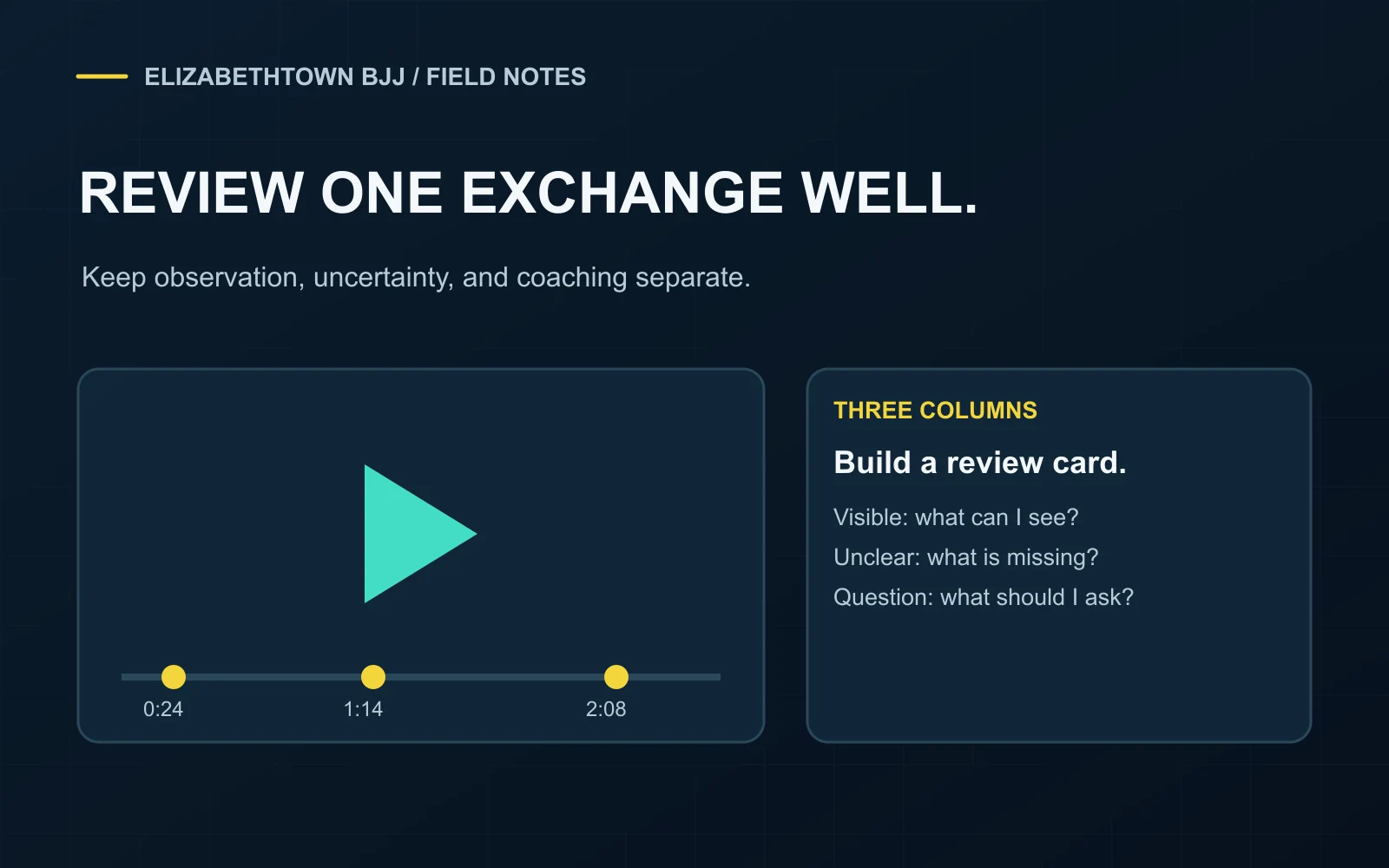
Start a match review with one question you want the video to answer. “Why did I lose?” is usually too large. “What happened before my opponent passed this guard?” points to a sequence you can locate and discuss.
You do not need to annotate every second. A few accurate observations, clearly separated from guesses, give a coach more useful material than a page of conclusions made from an unclear camera angle.
Confirm permission before recording or sharing footage. Class, organizer, venue, and participant rules can differ. Permission to record is not permission to publish; be especially careful with children, bystanders, and footage someone else owns.
First pass: watch the match as it happened
Watch once without repeatedly pausing. Note the ruleset, the visible score, and the broad changes of position. If you cannot see the scoreboard or hear the referee, write “not visible” or “not audible.” Do not reconstruct an official result from body language.
Choose two or three exchanges worth revisiting. They might include your first standing engagement, a repeated guard pass, or a moment when you reached a position you had been practicing. Include something that worked so the review does not become a list of faults.
Second pass: describe before explaining
Return to the first selected exchange. Start several seconds before the outcome that caught your attention. Write down the position, the visible grips or connections, and the order in which they change. Then mark the point where your own explanation becomes uncertain.
For a hypothetical note, “At 1:14, my opponent’s right hand reaches the collar; at 1:18, my shoulders turn toward the mat” is an observation only if the video clearly shows it. “I was mentally weak” is a judgment the video cannot establish. “The grip caused the whole pass” is a hypothesis to discuss, not a fact created by the timestamp.
Use three labels: Visible. Unclear. Question for the coach. Keep a guess out of the “visible” column until the evidence supports it.
Third pass: make one small review card
- Clip: The timestamp range and the ruleset.
- Start: The position and role you were in.
- Observation: The first clear change you can identify.
- Uncertainty: What the angle, audio, or your knowledge cannot resolve.
- Question: The decision you want help understanding.
- Follow-up: The exercise or correction the instructor actually recommends.
A hypothetical question could be: “In this guard exchange, should I have addressed the collar grip before changing my leg position?” Leave the answer blank until you discuss it. The purpose of the card is to support coaching, not to make a technical diagnosis from a blog example.
Hypothetical completed card: 0:42–0:49 / starting in guard / the upper-body connection changes before the pass / the camera hides one hand / “What should I recognize before that change?” / practice task to be agreed with the coach.
Your blank card: Timestamp: ____ / Start: ____ / Visible event: ____ / Uncertainty: ____ / Coach question: ____ / Agreed task: ____.
Check the rules before interpreting the result
A good escape may not be a scoring sweep. A final position may need a specific entry or stabilization before it scores. For an IBJJF example, consult the current rulebook resources and our scoring introduction. Use the organizer’s rules when reviewing another format.
If the clip does not show the entire exchange or referee decision, keep that limit in your note. A camera view can help you ask a better question without settling every disputed call.
Take the card back to training
Ask the instructor which observation matters first and how to practice it. The answer might involve reviewing a basic position, changing a decision, or studying a limited round. Record the recommendation in the last line of the card. Rewatch the selected sequence after that conversation and see whether you can recognize the detail you discussed.
Keep private review private unless you have the relevant permission to share it.
The academy’s Focus training article helps connect the review to a purpose for your next session. Bring one short clip and one answerable question. You can return to the other moments after you understand the first one.