
Drilling, Positional Sparring, and Rolling: What Each Is For
Understand three common BJJ practice formats and use a five-field practice card to clarify the task your instructor has assigned.
Published 3 min read
Editorial archive · . The archive date organizes this guide series. Publication is recorded above.
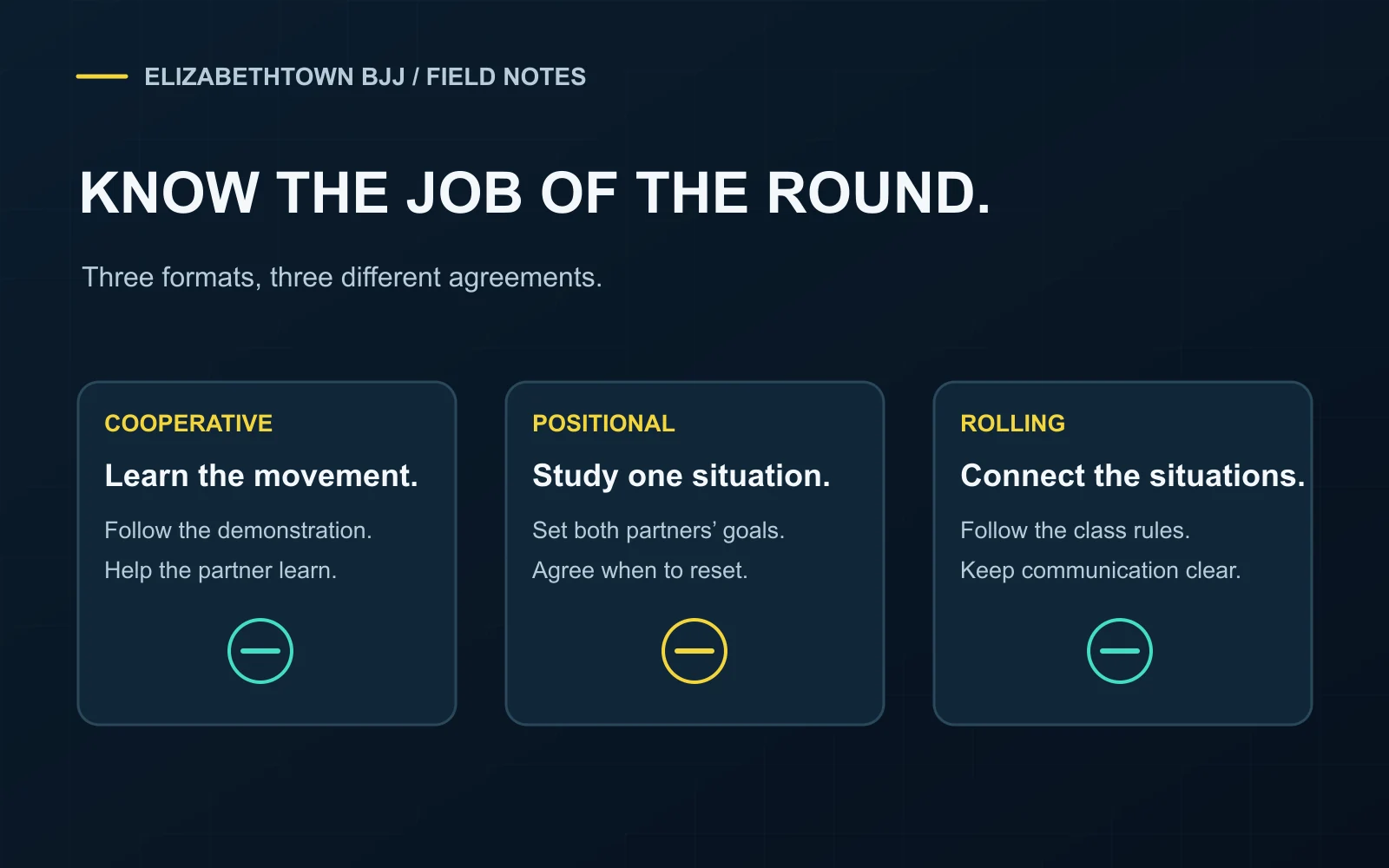
If you can repeat a movement but lose it as soon as a partner resists, ask which part you need to study. Cooperative drilling, positional sparring, and rolling let you examine different parts of that problem. The instructor can help choose the task that fits the question.
First identify the format assigned in class. Adding surprise resistance during a cooperative exercise changes your partner’s task. Turning a limited round into unrestricted sparring changes it again. Ask before changing the agreement.
Three formats, three questions
Cooperative drilling: “Do I understand the movement?”
Partners help each other repeat a demonstrated action and understand its sequence and placement. Ask what response the partner should provide. Cooperative does not mean careless; both people still need clear stop signals and attention to the instructor’s limits.
Positional sparring: “What happens at this reaction?”
Start from a chosen situation. Give each partner an agreed goal, define the permitted actions, and decide when to reset. The competing tasks introduce a specific problem without requiring every possible situation to remain in play.
Rolling: “Can I recognize and connect the situation?”
An open round can move through a broader range of positions under the class’s rules. Notice whether the situation appears and what leads into it. The round’s overall result will not tell you every detail about that particular decision.
Follow one example through all three
Here is a hypothetical guard-retention and passing problem to discuss with a coach. It describes practice formats, not a technique to perform without instruction.
- Clarify: In cooperative drilling, practice the guard movement the instructor demonstrated, with the partner providing the specified response.
- Limit: In a coached positional exercise, one partner works to retain the agreed guard while the other works toward a permitted pass. Set the start and the reset before adding resistance.
- Connect: In a normal round, watch for the same starting situation and the response you studied. Ask the coach about the moment you could not recognize.
Stephan Kesting’s targeted-sparring discussion offers a coaching perspective on limiting the problem. It does not establish the academy’s class format or prove that one method is always best.
Use a five-field practice card
- Start: Position, roles, and any agreed grips.
- Goals: What each partner is trying to do.
- Allowed actions: Techniques and resistance approved for this exercise.
- Reset: The exact event that ends an attempt.
- Stop signal: How either person can immediately pause the action.
Check the card together: If the partners describe different endpoints, resolve that before starting. A timer alone cannot define the task.
Reset the agreement when the exercise drifts
If a partner quietly becomes more cooperative, the other person may mistake the change for a successful adjustment. If the pace increases unexpectedly, the intended decision may disappear. Pause, describe what changed, and ask the coach whether to adjust the exercise.
Return to the starting position without rushing the other person. Switch roles as directed. A clear reset preserves the opportunity to study the problem again; continuing into every scramble answers a broader question.
Take the next question to the instructor
“I forget the first action,” “I lose it at this response,” and “I never recognize the moment” are different observations. Bring the one that describes your experience and ask which practice format would help investigate it.
The academy’s Focus training article explains choosing a purpose. This card helps define the actual partner task. For broader room expectations, use the open-mat guide and follow the instructor’s rules for the class you attend.