
Strength Training Alongside BJJ: Coordinate the Week First
A scheduling worksheet for discussing gym work and grappling together, without a one-size-fits-all lifting program or recovery promises.
Published 4 min read
Editorial archive · . The archive date organizes this guide series. Publication is recorded above.
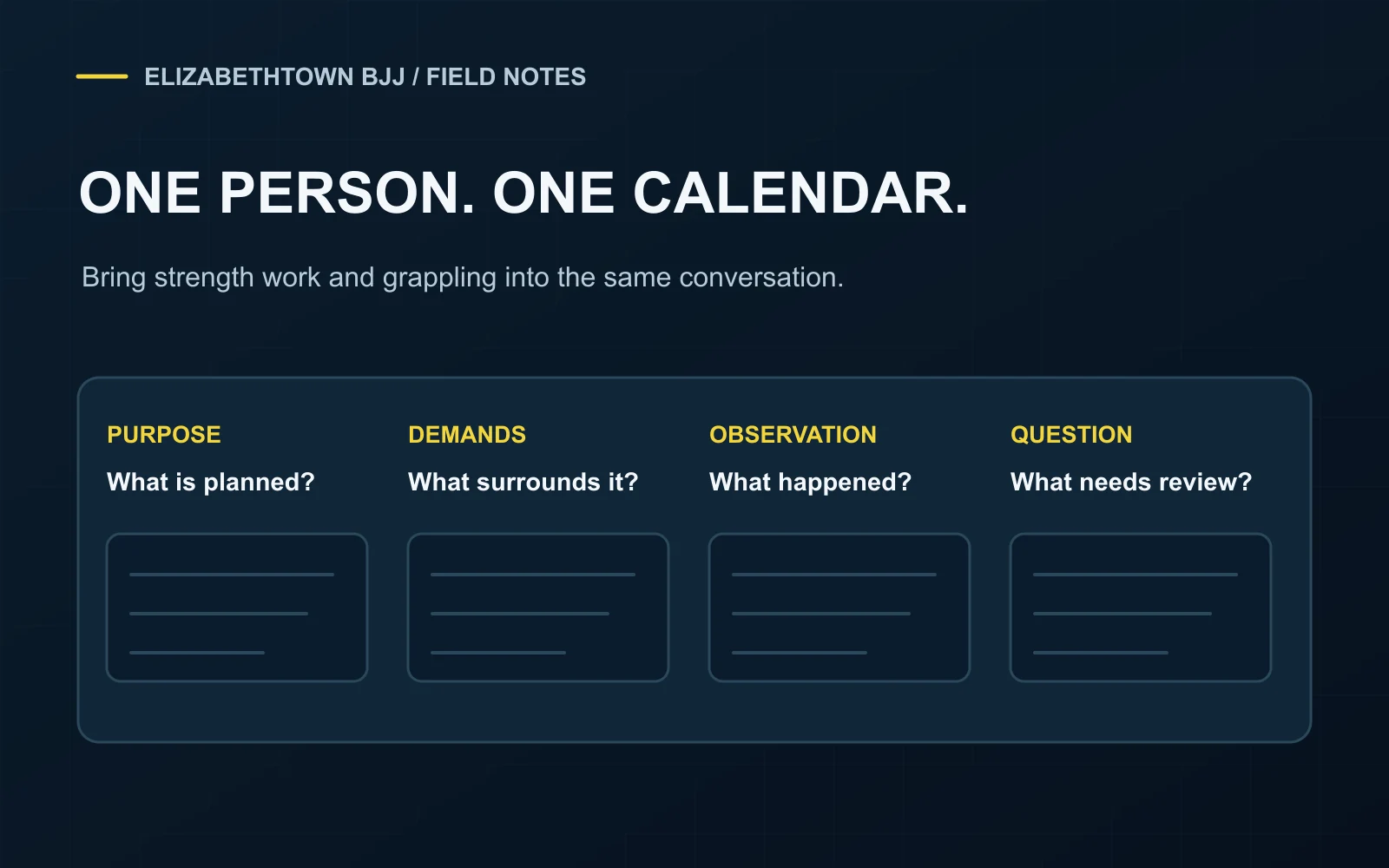
If you lift weights and train BJJ, put both on the same calendar before adding another session. Include what the sessions involve, not just their names. A demanding lifting session and a demanding grappling class still belong to the same person’s week.
This is a planning guide, not a personalized strength program. It does not prescribe exercises, loads, sets, or a medical return-to-training plan. Use qualified coaching for those decisions and appropriate healthcare advice for pain, injury, or other health concerns.
Write the week you actually have
Start with work, school, travel, family commitments, and the BJJ classes you can realistically attend. Add the strength sessions you already do. Include the time around each session: changing, travel, meals, and equipment care. A calendar that fits only when nothing runs late is difficult to keep.
Then note what each session is intended to accomplish. “Lift” is less informative than “strength session planned with my trainer.” “BJJ” might mean a technical class, a supervised limited exercise, or open rounds. Confirm the actual format rather than guessing from a calendar label.
Choose a current priority
You might be learning the basics of BJJ, preparing for a specific event, maintaining an established lifting routine, or simply finding a sustainable way to do both. State the priority for this period. It helps the people coaching you understand what you are trying to protect when the schedule becomes crowded.
A priority can change. It is a planning choice, not a statement that one activity is always more valuable. If a tournament is approaching, discuss the whole week with your instructor instead of independently increasing both lifting and grappling.
Keep a technical question separate from a strength goal. “I do not understand this position” is not enough information to prescribe lifting. Ask the BJJ instructor about the position and a qualified strength professional how to evaluate the strength goal itself. Winning more rounds is not a complete strength assessment.
Use a four-column planning sheet
- Session and purpose: What is planned, and who set that plan?
- Nearby demands: What training, travel, work, or other commitments surround it?
- Observation afterward: What did you actually do, and was anything different from the plan?
- Question or adjustment: What needs a conversation before repeating the week?
Hypothetical completed row: Session and purpose: strength session set by my strength coach. Nearby demands: BJJ class after work the same day. Observation: I cut the planned class practice short. Question: Can we review the placement of these sessions before repeating this week?
Change one thing you can evaluate: Agree on a specific adjustment, record what actually happens, and review it before adding another change.
Compare a normal week and a disrupted one
Example A: A hypothetical student has two confirmed BJJ windows and flexible options for strength work. The student marks those fixed windows, states the current strength goal, and asks the strength professional how the strength sessions should fit around them. The worksheet leaves the exercise selection and individual suitability to that professional.
Example B: Travel removes one of those windows. Instead of automatically stacking missed sessions into the remaining days, the student marks the change and asks which optional commitment to adjust. The goal is an explicit decision about the current week, not a debt of sessions to repay.
Share the information between coaches
A strength coach cannot account for grappling sessions they do not know about. A BJJ instructor may not know what you did at the gym that morning. Give each a plain description of the other activity and any restrictions that affect participation.
Useful questions include: “Which session should I prioritize this week?” “What should I tell my training partner about today’s plan?” and “Which change should we try first if the schedule is not working?” If an instructor needs more information, bring the written plan rather than an estimate made from memory.
Keep general guidelines in their proper place
The CDC’s adult activity guidance distinguishes aerobic activity from muscle-strengthening work. It does not turn every minute of a BJJ class into a particular exercise category. ACSM’s 2026 resistance-training guidance concerns individualizing strength work for healthy adults; it does not validate a universal BJJ lifting split. Use those broad references alongside advice appropriate to your circumstances.
For the BJJ side of the calendar, our training-frequency guide helps account for the practical time around classes. Check the academy’s current schedule, write down the week you already have, and take that sheet to the people helping you plan your training.