
From Wrestling to BJJ: Keep the Skills, Check the Rules
A transition guide for wrestlers: guard, submissions, clothing grips, and the habits to discuss before your first jiu-jitsu rounds.
Published 3 min read
Editorial archive · . The archive date organizes this guide series. Publication is recorded above.
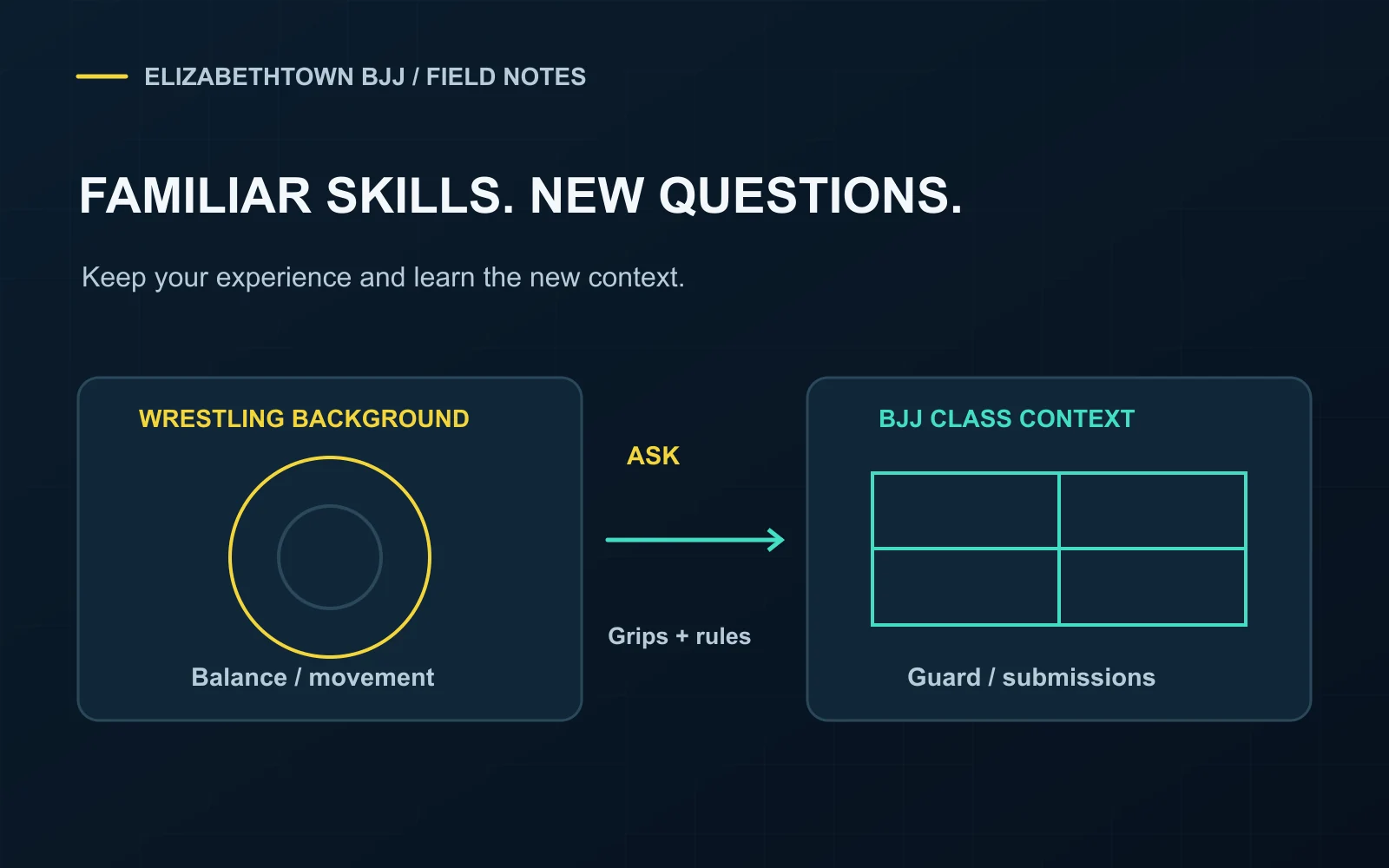
Wrestling experience gives you familiar ways to move, balance, and work against resistance. Your first BJJ class also asks you to recognize problems that wrestling may not have asked you to solve. Start by telling the instructor which style of wrestling you trained and how recently you practiced.
The most useful adjustment is curiosity about the rules and positions. You do not need to pretend you are new to grappling. You do need to learn where a familiar reaction leads in this different setting.
Your back touching the mat has a different meaning
In BJJ, a person on their back can use guard to control distance, attack, or work toward coming on top. Touching the mat with your back is not itself a wrestling-style pin that ends the match. That makes the guard position worth learning even if your first preference is to stay on top.
It also changes how you interpret a partner’s choices. Someone who sits to guard is not necessarily giving up on the exchange. Ask the coach what the person is controlling with their legs and grips. Our first-month guide provides a starting vocabulary.
A familiar movement can enter an unfamiliar submission
Ask for instruction on posture, neck and arm exposure, and the academy’s permitted techniques before you add resistance. If you do not recognize a position, stop and ask. Trying to explode through an unfamiliar submission can create a problem your wrestling background did not prepare you to identify.
Practice the stop signals with the instructor. When a partner taps or asks to stop, release immediately. When you need to stop, signal clearly. Do not use pain as the only sign that it is time to end an exchange.
For competition, check the organizer’s rules for your exact division and ask how previous wrestling experience affects eligibility. Being new to BJJ alone does not settle entry placement.
Try a learning goal that uses both backgrounds
For an instructor-approved partner exercise, you might study the moment after a takedown: which position did you land in, what are the legs doing, and what control needs to be established next? Ask the instructor to set the task and any reset rule. You can learn more from that transition than from proving that you can repeat the entry.
Take a turn in a role that is unfamiliar, too. Working from guard under instruction gives you information you cannot get by avoiding the bottom every round. The purpose is to understand the task well enough to choose a response.
Introduce your experience without turning it into a challenge
A useful introduction is simple: “I wrestled folkstyle in school, have been away for a few years, and have not trained submissions. Which class is the best place to start?” Change the details to match your actual experience. There is no need to test yourself against the first person you meet.
Before coming to Elizabethtown Jiu-Jitsu, contact the academy about the right entry point and check the current schedule. Bring the experience you have and leave room to learn the differences.