
Entering the Back Crucifix: Why Direction Matters
Study John Danaher’s backward and forward entries from turtle, and learn what to notice when a partner resists the first route.
Published · · by Elizabethtown BJJ
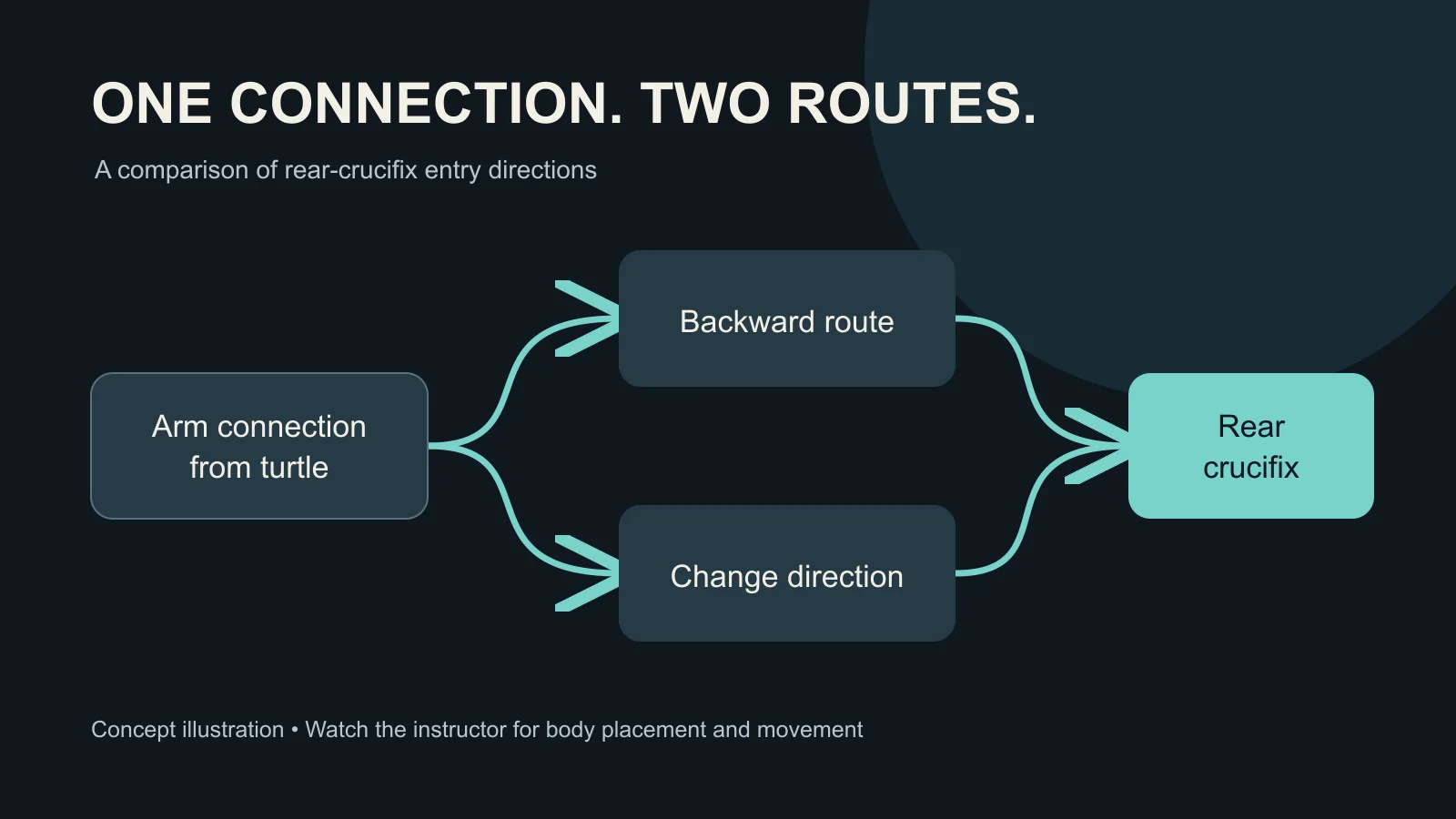
An entry can start well and still stall. You have found the arm, but the partner will not move in the direction you expected. In John Danaher's short back-crucifix lesson, that resistance becomes a choice between two routes rather than a reason to pull harder.
For a beginner, the useful question is specific: what changes when the backward route stops working?
Recognize the position before following the movement
The lesson begins with a partner in turtle, supported on knees and arms. The attacker works beside them and captures an arm with the legs. This is an entry to the rear crucifix: the legs control an arm instead of taking the familiar leg hooks used in conventional back control.
That distinction matters when you watch. Following only where the attacker lands can make the two entries look like unrelated rolls. Follow the captured arm as well. Where does it stay connected, and which direction does the partner's body travel?
If rear crucifix is unfamiliar, ask an instructor to show the starting position and the settled position first. Seeing those two endpoints gives the movement between them a purpose.
Two routes, one entry problem
In the official BJJ Fanatics clip, Danaher demonstrates a backward entry, then an alternative when the partner stiffens against the backward pull. The second route turns the partner across the attacker's body and arrives in rear crucifix on the opposite side. Both demonstrations begin from turtle with an arm captured; the lesson compares entry directions rather than submission finishes.
Watch the backward example once without trying to memorize every limb position. On the next viewing, look for the partner's resistance before the direction changes. The point worth discussing is the response that prompts a different route, rather than how quickly someone can reproduce the turn.
The demonstrations are cooperative explanations. They show a decision to study, not proof that either entry will work against every reaction in a live round.
Watch the lesson
“How to Master the Back Crucifix - Fall Back Vs Fall Forward by John Danaher.” Published by BJJ Fanatics, July 1, 2025; 3 minutes 12 seconds. Watch on YouTube.
The publisher's course outline places the backward-versus-forward comparison among turtle entries. It treats finishing and other entry families separately. Keep this short lesson's task equally narrow: recognize the route into the position.
Make the comparison observable in practice
Bring one question to an instructor: “Can you show the reaction that makes you change direction here?” Have them choose the version and pace appropriate for you, including how the partner should respond. A video alone cannot judge whether you are reproducing the contact or movement correctly.
Compare the two versions from the same instructor-approved start. At each reset, identify three things in ordinary language: the arm connection you began with, the response you felt, and the side on which you finished. If you cannot name one of those, pause there and ask for a demonstration rather than adding speed or force. Release for a tap or spoken stop.
This is a comparison task, not an invitation to improvise a rolling entry with a trapped partner. Let the instructor supervise the movement and set the resistance. The academy's practice-formats guide explains how a defined drill differs from positional sparring.
Already studying conventional back control? Use that familiar position as a point of comparison, while noticing that the legs have a different job here. New to the mat? Explore the beginners program and bring the question, without needing to arrive able to perform the entry.