How Should a BJJ Gi Fit? A Try-On Checklist
Check movement, jacket closure, sleeves, trousers, and care instructions before committing to a Brazilian Jiu-Jitsu uniform.
Published 4 min read
Editorial archive · . The archive date organizes this guide series. Publication is recorded above.
A gi size label is a starting point. The useful test is whether the jacket and trousers fit your body, allow the movements your instructor asks for, and meet the requirements of the class or event where you will wear them.
Before buying, ask the academy about its current uniform requirements. Then read the manufacturer’s measurements, care instructions, and return policy. Different brands and cuts can use the same size name without fitting the same way.
For a first-party example, FUJI’s BJJ size chart separates cuts and measurement ranges. Use the chart for the exact product you are considering; it is not a recommendation to buy that brand or a universal sizing standard.
Check the jacket while standing and moving
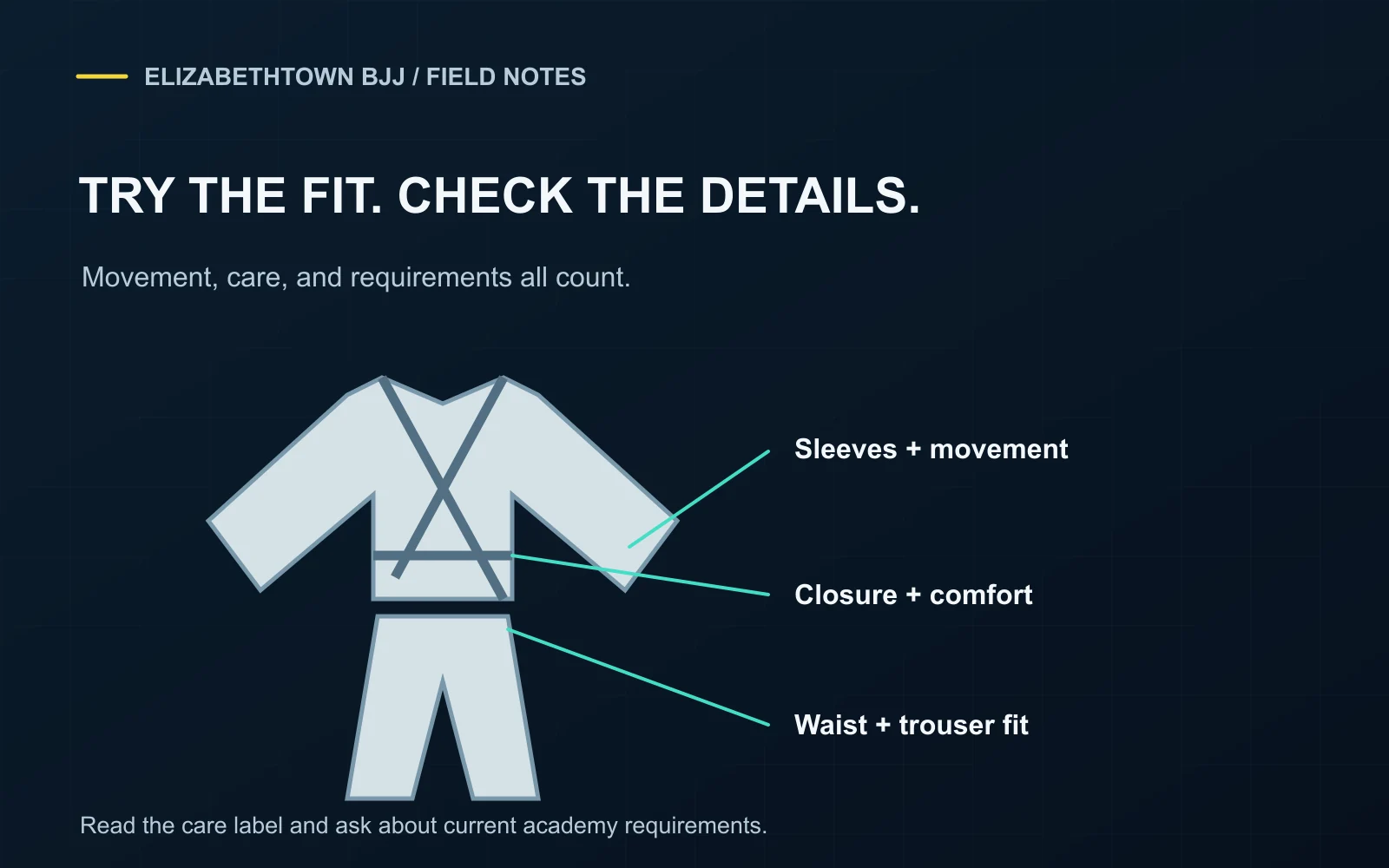
Put the jacket on as it will be worn for class, including any underlayer the academy requires. Close it normally and tie the belt with help if needed. Check whether the front overlaps without being forced and whether the collar sits comfortably.
Reach forward and raise your arms through a comfortable range. Notice pulling across the upper back, shoulders, or armpits. Try the basic movements your instructor has already taught you. You are checking the garment, so there is no need to attempt unfamiliar rolls or ground movements in a shop or at home.
Also notice excess fabric that bunches or interferes with your hands. A looser jacket is not automatically a better beginner jacket, and choosing a very tight cut to make gripping harder can create movement or rules problems.
Check the trousers in more than one position
Secure the waistband properly and check that the trousers remain in place. Bend the knees and hips within your comfortable range, and sit down. Pay attention to pressure at the waist, seat, and knees. Check whether the cuffs catch under your heels or rise unexpectedly when you move.
Make sure you understand the tie or drawstring system. If you have to keep adjusting the trousers while standing still, resolve that fit question before taking them into partner training.
Use this six-point fitting note
- Closure: Can the jacket close and the trousers fasten without forcing them?
- Movement: Is there pulling or bunching during familiar movements?
- Length: What happens to sleeves and trouser cuffs as you move?
- Finish: Are seams, ties, and labels comfortable and intact?
- Care: Can you clean and dry this garment as instructed between your classes?
- Requirements: Does this model meet the academy’s rules and any event you are actually entering?
Write down the manufacturer, model, size, and measurements that worked. If you borrow a gi for a fitting with permission, record those details rather than remembering only that it was an “A2.”
If you fall between two sizes, ask the maker about that model’s measurements and return terms. If movement feels suitable but event compliance is uncertain, ask the coach to inspect the uniform against the organizer’s rules. Those are two different questions; a size label cannot answer either by itself.
Ask about shrinkage before using the laundry as a fitting tool
A manufacturer may describe a garment as preshrunk or give an expected change after washing. Treat that information as specific to the product. Do not assume every gi will shrink by a standard amount, and do not buy an unusable fit on the assumption that you can fix it with heat.
Read the return conditions before washing or training in a new uniform. Keep the gear-care routine in mind as well: a uniform has to be practical to clean, not just comfortable for a five-minute try-on.
Before removing the tags: Resolve the fit, care, return-policy, and academy-requirement questions together. A cheap purchase becomes expensive if it cannot be used for the class you intended.
Competition fit is a separate check
The IBJJF uniform page specifies details for its events, including permitted uniform features and inspection requirements. Another organizer may use different rules. A gi accepted for ordinary training is not automatically approved for every competition.
For an event, check the current rules for your division and ask the coach to review the actual uniform before the event day. For a first class, confirm what the academy wants you to bring before buying. The gi versus no-gi guide can help you identify which clothing category you need first.