
Judo for BJJ: Start With Balance, Then Study the Transition
Questions about balance, grips, receiving a technique, and the position after a takedown, for supervised BJJ stand-up learning.
Published 3 min read
Editorial archive · . The archive date organizes this guide series. Publication is recorded above.
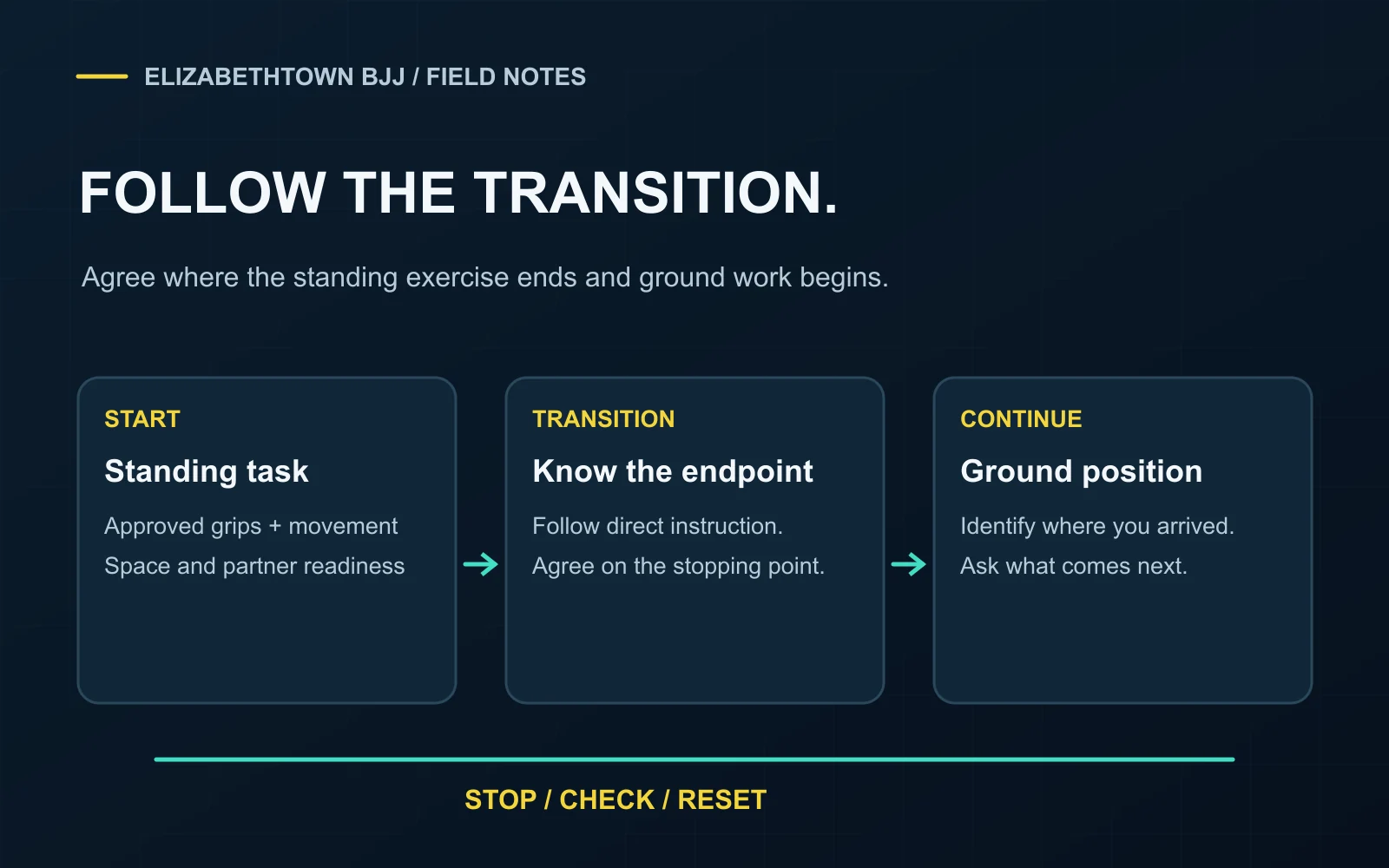
Before collecting another throw, ask what makes its entry possible. Where is the partner’s balance? What reaction does a grip create? Can both people receive the exercise appropriately? What BJJ position follows the landing? Those questions connect stand-up practice to the rest of your grappling.
Judo offers a context for studying grips, posture, movement, and off-balancing. Wrestling also develops stance, ties, movement, and control. Neither sport owns those ideas. The useful question is what your current instructor wants you to notice and how it fits the BJJ task.
Name the problem before naming the throw
Kuzushi means off-balancing. In a coached exercise, ask which change in balance or posture you are studying and what response the partner should give. Do not treat the word as a trick that removes the effects of size, strength, or experience.
The IJF Academy handbook lists grips, movement, postures, combinations and transition to groundwork in its UDJC tachi-waza assessment. That is a teaching framework to learn from, not evidence that an academy offers a particular judo class.
A grip begins a question
Securing fabric gives you a connection. Ask what movement or information that connection makes available in the exercise. A familiar grip does not itself tell you whether the partner is in the right position for an entry or what follow-up is permitted.
Tell the instructor what you have practiced before, including any judo or wrestling background. Ask which movements fit this class, these partners, and the available space. A technique you know from another ruleset may need a different task or may be inappropriate for this exercise.
Receiving deserves its own instruction
Ukemi refers to receiving or falling skills. Learn those progressively through direct, qualified instruction on a suitable surface, with an appropriate partner. A written article cannot teach or approve a breakfall, and a padded floor does not remove the risks of standing grappling.
The IJF’s discussion of learning to fall emphasizes supervised progression and the responsibility of the person applying the technique. Ask the coach to choose the exercise and its stopping point. If you do not understand how you are expected to receive it, pause before the attempt.
Ask what happens after the landing
A BJJ exercise may continue into guard, top control, or another ground position. Identify that intended continuation before starting. A landing that completes one sport’s exercise can begin another sport’s next problem.
Ask which ruleset is relevant. Competition permissions and outcomes differ. The IBJJF rules resources are one BJJ reference; they do not establish rules for every event or every standing exercise in class.
Look earlier when an entry fails
In a hypothetical review, a student notices that an attempted entry began from an unhelpful distance and a grip that did not produce the intended reaction. The useful question is about that earlier setup. Adding another throw may leave the same setup question unanswered.
The wrestling crossover guide covers other background-specific adjustments. For practice formats, use the drilling and sparring guide. Ask the current BJJ instructor how supervised standing work can connect to your learning goal before arranging extra training or assuming a separate judo service exists.